


Your reps may already use AI to draft follow-up, turn transcripts into notes, and prepare for calls. The work is faster, and the outputs often look polished. But a polished output can hide an execution gap.
A seller can receive a perfect AI summary and still enter the next conversation without a clear objective. The CRM can be current while discovery remains shallow. A professional follow-up can still fail to secure a meaningful buyer commitment.
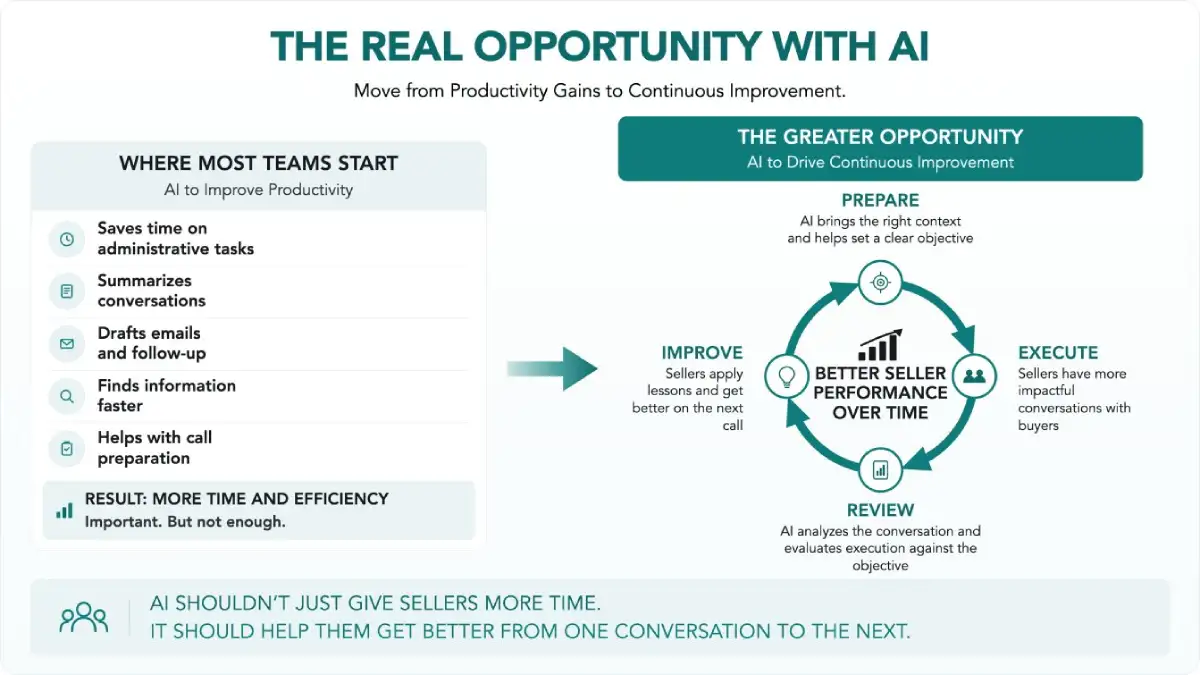
The greater opportunity is to move from using AI to improve productivity to using AI to improve seller performance over time. That means using AI to help sellers prepare, execute, review, and improve from one conversation to the next.
Seller Improvement Does Not Happen Automatically
Giving a seller better notes or more preparation time does not guarantee better execution.
The real challenge appears during the conversation. A buyer asks for a demonstration earlier than expected. A senior stakeholder joins without warning. The meeting runs short. The seller abandons the plan, moves to the solution too quickly, or accepts a vague answer to keep the conversation moving.
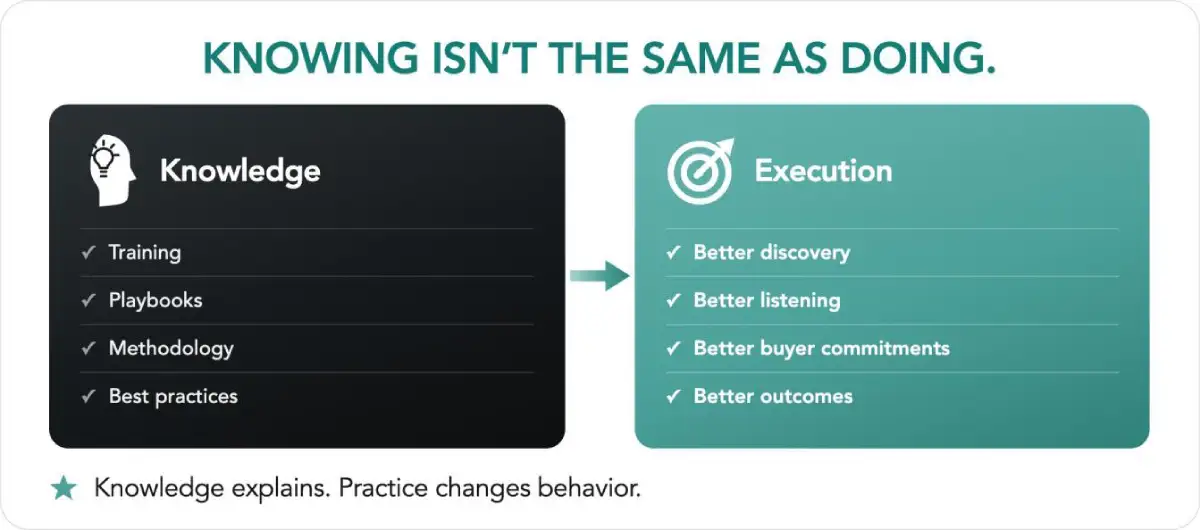
Most sellers know what they are supposed to do. The difficulty is applying the sales process consistently when the conversation becomes unpredictable.
Traditional sales training and coaching rarely reaches the seller in that moment. A workshop may explain good discovery, but it cannot remind the rep before a difficult call which question they missed last time or which habit keeps showing up.
Sellers do not need more information after every call. They need relevant reinforcement before the same situation happens again.

Start With a Clear Objective Before the Call
Improvement starts before the call.
Preparation should produce more than an agenda. It should give the seller a clear purpose for the conversation and one behavior to practice.
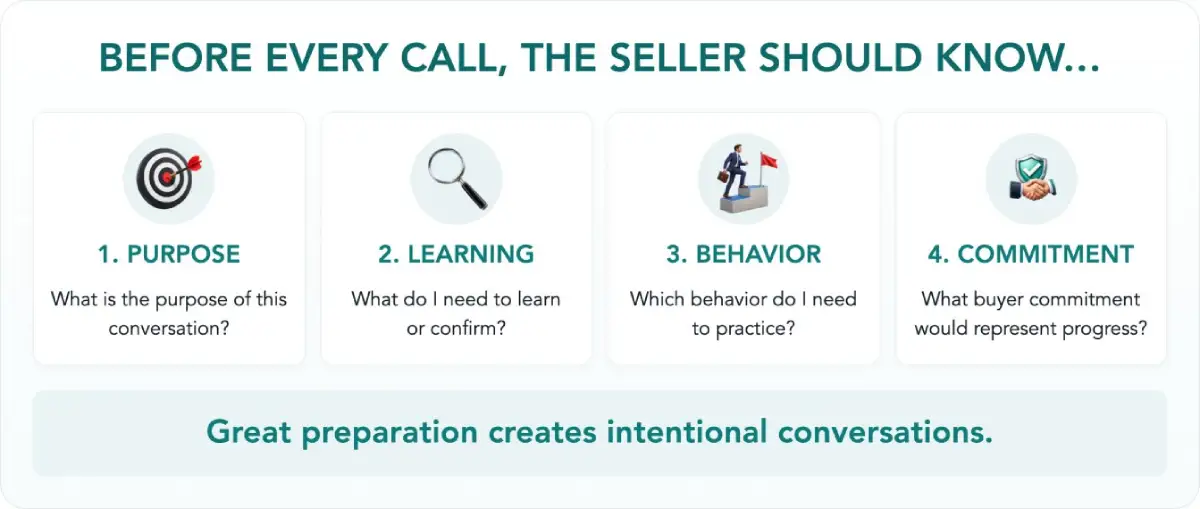
AI can bring together prior conversations, open questions, known stakeholders, unresolved concerns, and the outcome the seller hopes to earn. Before joining the call, the rep should be able to answer four questions:
- What is the purpose of this conversation?
- What do I need to learn or confirm?
- Which behavior do I need to practice?
- What buyer commitment would represent progress?
A weak plan says, “Review the platform and discuss next steps.”
A stronger plan says, “Understand the operational impact, test why the issue matters now, and earn agreement to involve the people affected by the decision.”
The plan gives the seller a purpose. It also creates a standard for evaluating the call afterward.
Review the Seller’s Execution, Not Only the Transcript
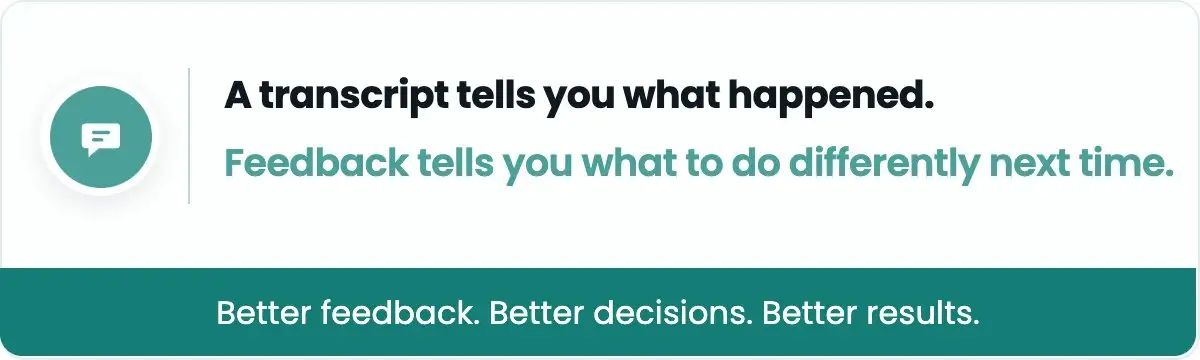
A transcript records the conversation. A summary organizes it. Neither one explains whether the seller executed well. After the meeting, AI should compare what happened with the seller’s objective and the behavior they intended to practice.
Did the rep ask the planned question? Did they listen long enough for the buyer to explain the problem? Did they lead the answer? Did they move to the solution too early? Did they confirm a clear next step?
A summary might say, “The buyer requested a case study and asked about implementation.”
Useful feedback goes further: “The seller answered the implementation question but did not explore what created the concern or how it might affect the decision. On the next call, ask what risk the buyer is trying to reduce before presenting the case study.”
A summary explains what was said. Feedback identifies what the seller should do differently.
Turn Every Call Into a Feedback Loop
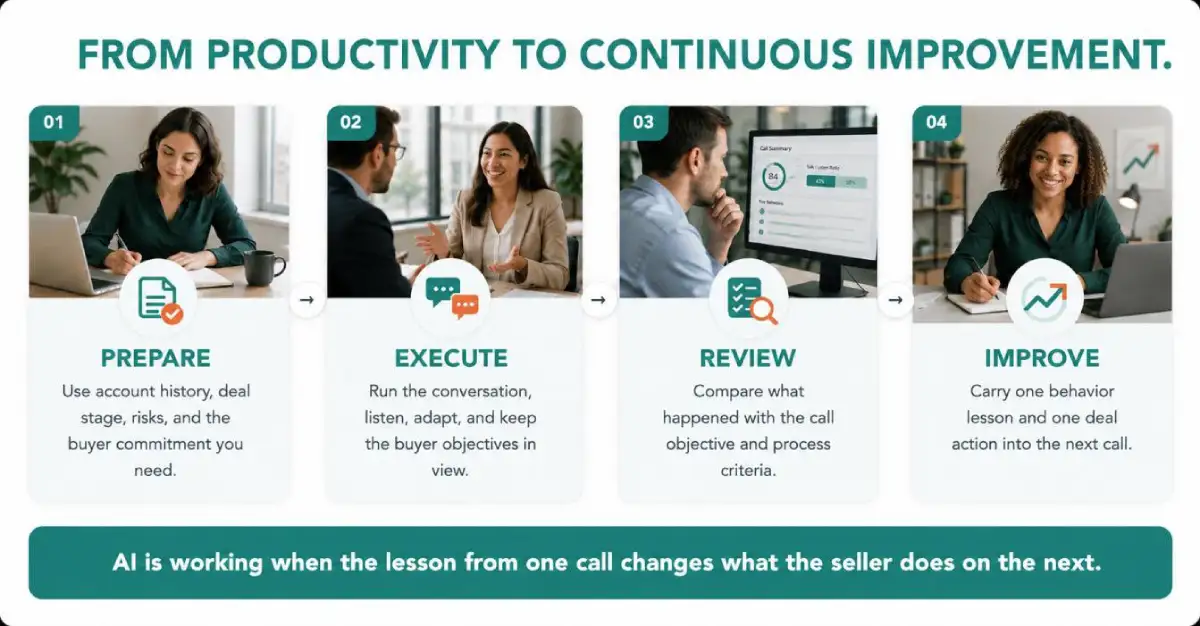
The value compounds when preparation and review become part of one continuous cycle.
- Prepare: Enter the call with a clear objective and one behavior to practice.
- Execute: Stay present, listen, adapt, and guide the conversation.
- Review: Compare what happened with the plan and identify the most important execution gap.
- Improve: Carry one lesson into the next call.
A rep may understand what the opportunity needs and still lack the behavior required to get there. Improvement must address both knowledge and execution.
Repeated across calls, the cycle builds judgment, confidence, and stronger habits.
Look for Patterns, Not Isolated Mistakes
One difficult call may be situational. A repeated behavior is a development need.
AI can identify patterns that are hard to see when calls are reviewed one at a time. A seller may consistently ask surface-level questions, interrupt buyers, introduce the solution too early, accept vague answers, or leave without a clear commitment.
A useful pattern sounds like this: “Across your last six discovery calls, you introduced the solution before the buyer had fully described the operational impact.”
That is more useful than saying, “You need to improve discovery.” It is specific, observable, and connected to real conversations.
Pattern detection should preserve context: what happened, how often it occurred, where it appeared in the sales process, and whether the behavior is improving.

Reinforce Behavior, Not Only Tasks
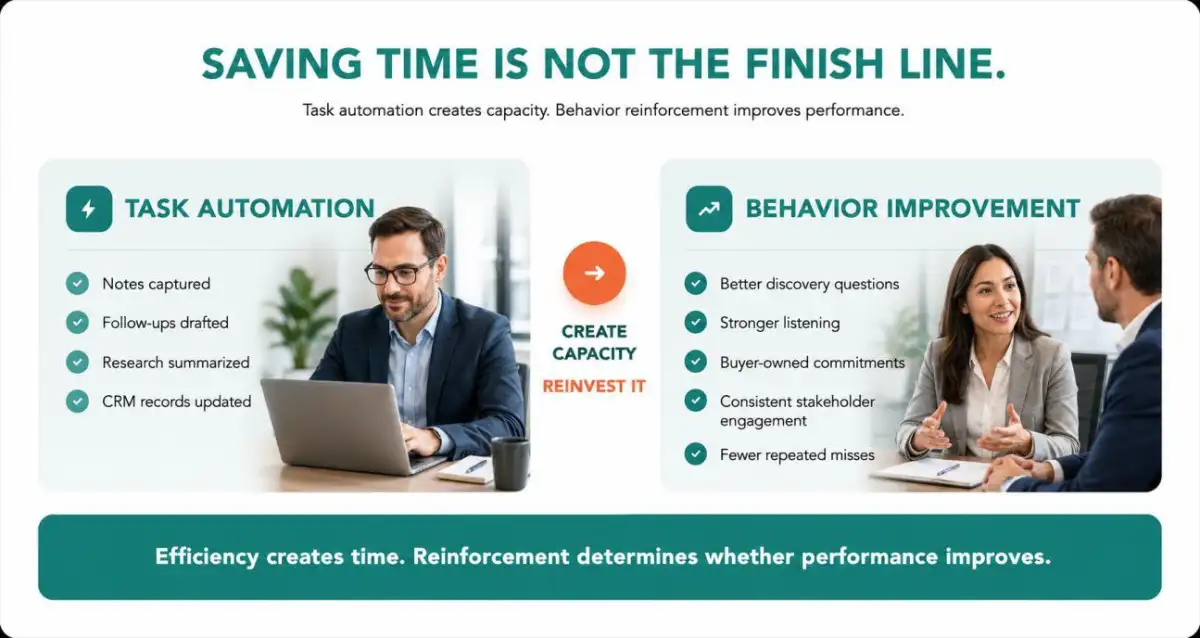
Once a pattern is visible, AI should help reinforce a different behavior. Performance changes when the seller uses the information to ask better questions, listen longer, test assumptions, confirm clearer commitments, and avoid repeating the same mistake.
The useful question is not, “Did AI complete the task?” It is, “Did the task help the seller behave differently?”
Notes should help the rep separate facts from assumptions. Follow-up should reflect what the buyer said and agreed to. Research should improve the questions the seller brings to the conversation.
Efficiency creates time. Reinforcement determines whether performance improves.
Reinvest the Time AI Saves
AI can return meaningful capacity by reducing administrative work. Gartner reported that AI saves sellers an average of 4.8 hours per week, yet 72 percent of sales organizations report low reinvestment of those savings into higher-value activities.
Saving time does not improve performance unless the organization decides where the time goes. Recovered capacity should return to buyer conversations, thoughtful preparation, deliberate practice, account development, and coaching.
Saving five hours matters only when those hours improve how the rep sells.
Measure Whether Improvement Carries Forward
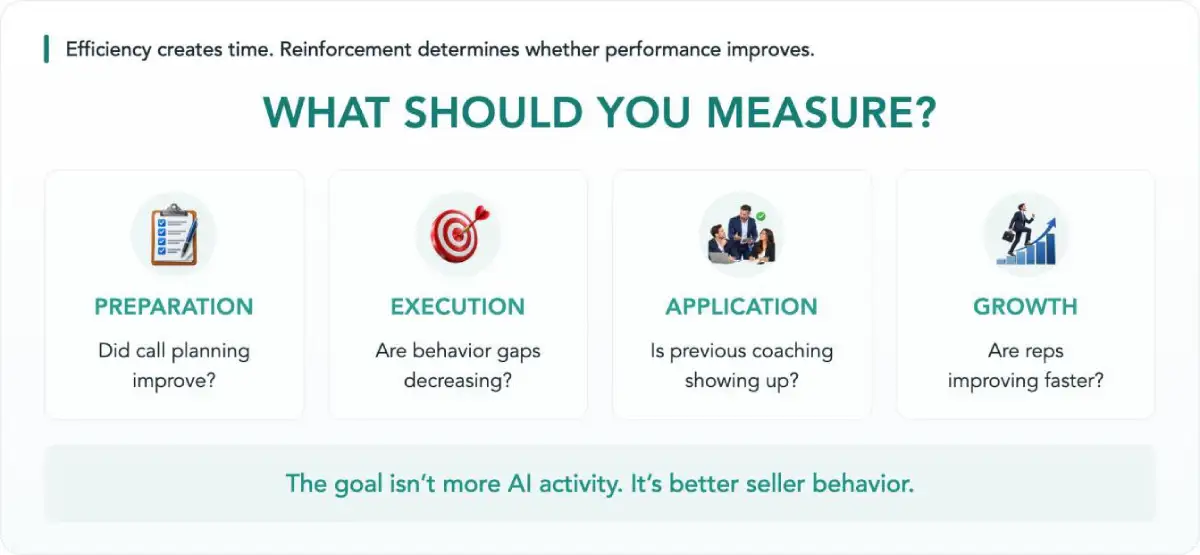
Counting prompts, summaries, or AI-generated emails proves adoption. It does not prove improvement. The stronger question is whether the lesson from one call appears in the next.
- More consistent use of call plans
- Fewer repeated behavior gaps
- Evidence that sellers apply prior feedback
- Faster progress toward proficiency for new reps
Start with the two or three behaviors most connected to weak execution. Establish a baseline and look for evidence that the same behavior gap becomes less frequent over time.
The goal is not more AI activity. It is more consistent seller behavior.
Every Call Should Make the Next One Better
Sales AI is improving execution when sellers enter conversations with clearer objectives, feedback becomes more specific, repeated gaps become less frequent, and lessons from one call show up in the next.
Healthcare buyers do not need scripted sellers. They need prepared, curious, adaptable guides who can stay present when the conversation changes. AI should support that judgment, not replace it. It should help sellers arrive with context, learn from evidence, and apply the lesson while the opportunity is still active.
The real value of sales AI is not a better call summary. It is a better seller on the next call.
Key Takeaways
- Productivity gains do not automatically improve seller performance.
- AI should connect preparation, execution, review, and improvement into one repeatable cycle.
- A summary explains what happened. Feedback identifies what the seller should change.
- Patterns across several calls are more useful than isolated observations.
- Recovered time should return to buyer-facing work and deliberate practice.
- The clearest measure of AI value is whether lessons from one call appear in the next.
See How SAMI.ai Turns Every Call Into a Step Forward
SAMI.ai is an AI sales performance system that runs inside the tools your team already uses. It captures every conversation, evaluates execution against your sales process, and delivers focused feedback automatically, with zero workflow changes.

Source: Gartner, “Gartner Survey Finds AI Saves Sellers Nearly Five Hours Per Week, Yet 72 percent of Sales Organizations Fail to Reinvest Time in High-Value Activities,” May 19, 2026.
