
AI Is Already in Your Healthcare Sales Process. Is It Making the Team Better?
A practical guide to using AI to find better opportunities, move deals forward, improve seller execution, and scale sales leadership in healthcare B2B.

Ginny Mahaney

The question is no longer whether your team is using AI. The question is whether any of this activity is making the team better.
Can you identify where AI improves pipeline quality? Do you know which sellers are using it effectively? Is it helping opportunities move based on buyer action, or producing more content, summaries, and dashboards?
According to McKinsey’s most recent global survey, 88 percent of organizations use AI in at least one business function. Yet much of that activity remains stuck in pilots or individual habits rather than becoming a shared organizational practice.
 The healthcare B2B sales teams pulling ahead will not be the ones with the most AI tools. They will be the teams that turn AI into more consistent behavior across accounts, calls, deals, and coaching.
Healthcare B2B Needs a Different AI Playbook
Most conversations about AI in sales start with efficiency: writing faster, researching faster, and summarizing faster. Speed matters, but healthcare sales breaks down in places where speed alone does not help.
A healthcare opportunity may involve clinical leaders, finance, information technology, security, procurement, operations, and executive sponsors. The sales cycle can stretch across many months. A deal can appear healthy while a critical stakeholder remains disengaged or an internal advocate has no influence.
The consequences of a missed step compound. A weak discovery conversation does not only create a poor meeting. It can lead to a business case that never gains financial support, a proposal that reaches procurement too early, or a forecast built on enthusiasm rather than proper evidence.
AI should do more than help healthcare sales teams work faster. It should also help them make better decisions and execute their sales process more consistently.
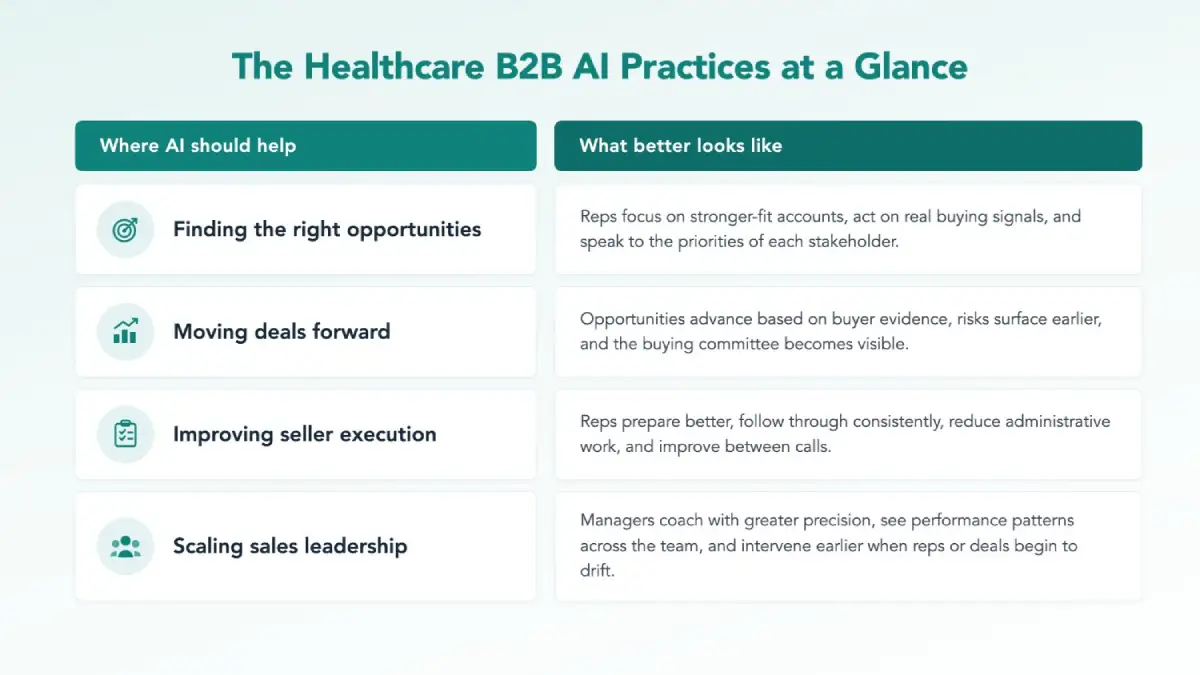
There are four places where that improvement should be visible.
1. Finding the Right Opportunities
Healthcare has a finite universe of health systems, providers, payers, technology companies, and service organizations. Sales teams can identify most of the accounts that will ever fit their market. Yet many still treat every name in the CRM as equally worthy of a rep’s time.
AI can help teams focus.
It can combine account characteristics, clinical priorities, financial signals, technology environments, service-line strategies, and market events to identify which organizations are more likely to have a meaningful reason to engage.
Modern sales intelligence platforms can alert teams to the events that often create buying urgency. AI can then help sellers quickly understand why the change matters, how it affects the account, and how to tailor their outreach.
For example:
- A new executive joins the organization
- A merger, acquisition, or strategic affiliation
- A reimbursement or regulatory change
- A quality or performance issue
- A major technology initiative or platform change
- A funding event or strategic growth initiative
These are the moments when organizations are already evaluating change.

AI can also help teams judge whether an opportunity is worth pursuing by comparing the account’s needs, priorities, and stakeholder mix with the problems your company is best positioned to solve.
The goal is not more outreach. It is more time spent on accounts with a clear reason to act.
What success looks like
- Reps spend more time with high-fit accounts.
- Outreach is triggered by meaningful buying signals instead of arbitrary cadences.
- Meetings increase with organizations that have a clear reason to change.

2. Moving Deals Forward
A seller finishes a good meeting and moves the opportunity to the next stage. But did the buyer do anything that shows the deal actually moved forward?
A meeting can feel productive without producing meaningful movement. The buyer may have enjoyed the conversation but made no commitment. A new stakeholder may have joined without supporting the initiative. A next meeting may be scheduled without any progress toward a decision.
AI can help teams examine the evidence behind deal progression and assess whether the opportunity is truly healthy:
- Did the buyer confirm the problem?
- Has the urgency survived conversations with multiple stakeholders?
- Is there a clear decision process?
- Does the economic case have buyer-owned numbers?
- Is an internal advocate taking action?
- Are the right people engaged?
- Did the meeting end with a meaningful commitment?
AI can also compare this evidence with the CRM stage. A healthy deal is not one with every field completed. It is one with buyer-confirmed proof that the opportunity is structurally strong enough to keep moving.
Want a more rigorous way to assess deal health?

This is where AI can expose risk earlier. A single-threaded opportunity, missing financial case, quiet stakeholder, unclear procurement path, or unsupported CRM stage should not remain hidden until the forecast meeting.
Healthcare deals often die quietly. The visible loss occurs at the end. The conditions that caused it appeared months earlier. AI can help leaders see those conditions while there is still time to act.
What success looks like:
- Deals advance because buyers make commitments.
- Deal health is assessed against buyer-confirmed evidence.
- Risk is identified early enough to act.
- Forecasts reflect the true condition of the pipeline, not CRM completion.

3. Improving Seller Execution
The real test of sales AI is not whether it produces a polished summary. It is whether the rep is better prepared for the next conversation.
Before a call, AI can bring together the CRM stage, account history, prior meetings, stakeholder roles, open questions, and objectives. It can help the seller enter the conversation with a plan instead of relying on memory.
After the call, it can draft follow-up, update records, identify missing information, and prepare the next step.
This work matters because administrative demands pull sellers away from buyers. According to Gartner, AI saves sellers close to five hours per week on average. Saving time, though, is not the outcome. The outcome depends on where that time goes.
Gartner also found that 72 percent of sales organizations fail to reinvest those recovered hours into higher-value selling activities. The organizations seeing the greatest impact treat time savings as an opportunity to improve execution, not simply reduce administrative work.
 Recovered hours should go back into the activities that move deals forward:
- Buyer conversations
- Account development
- Meeting preparation
- Deal strategy
- Stakeholder engagement
AI should also reinforce the sales process between formal training sessions. Most sellers do not forget what they learned. They revert to familiar behavior under pressure. They skip questions, move too quickly to the solution, or leave a meeting without confirming the next decision.
A workshop cannot correct those moments three weeks later. AI can help identify gaps after each call and provide feedback grounded in a live opportunity. This turns training from an occasional event into a working practice.

What success looks like:
- Reps prepare more effectively.
- Follow-up is more consistent.
- Best practices show up on every call, not just after training.

4. Scaling Sales Leadership
A sales leader can attend only a small share of the team’s calls. That creates a structural coaching problem.
Managers coach from the conversations they happened to hear, the deals reps choose to discuss, and the information entered into the CRM. They know important signals are missing, but they do not have enough hours to review every interaction.
AI changes the math. It can analyze more calls, surface repeated behavior gaps, identify deals that need intervention, and help managers focus their limited time.
This does not replace leadership. It gives leaders better evidence. Instead of telling a rep, “You need to improve discovery,” a manager can coach from a pattern.
That is specific. It is observable. It is coachable.
 The same evidence can improve forecasting. A stage label becomes less persuasive when the calls show missing stakeholders, unclear urgency, or no buyer-owned business case.
AI can also help leaders improve how they coach.
After a deal review or coaching conversation, AI can assess not only what the rep said, but how the leader responded. It can identify when the manager gave the answer instead of helping the rep think through the problem. It can flag missed follow-up questions, shallow probing, or moments when the conversation moved on before the rep reached the real issue.
For example, AI might point out that the leader:
- Told the rep what to do instead of coaching the rep to reach the conclusion
- Accepted a surface-level answer without probing further
- Missed an opportunity to test the rep’s assumptions
- Focused on the deal outcome without addressing the behavior behind it
- Ended the conversation without helping the rep define what to do differently next time
This gives leaders a view into their own coaching patterns, not only the rep’s performance.
The goal is not to automate coaching. It is to help managers become more intentional, ask better questions, and turn each deal review into a learning experience the rep can apply on the next opportunity.
What success looks like:
- Managers coach more precisely.
- Rep development becomes measurable.
- Forecast confidence improves.

Where Should Your Team Start?
The answer depends on the problem you need to solve.
| If your biggest sales problem is… | Start by using AI to… | Continue here |
|---|---|---|
| Sellers spend too much time on the wrong accounts | Improve account prioritization and identify meaningful buying signals | Stop Chasing Every Account: How AI Helps Healthcare Sales Teams Find the Right Buyers at the Right Time |
| Deals appear active but fail to progress | Understand buyer behavior, stakeholder engagement, and deal risk | Your CRM Says the Deal Advanced. The Buyer May Disagree. |
| Rep execution varies from one call to the next | Improve preparation, follow-up, and reinforce best practices between conversations | The Real Test of Sales AI: Are Your Reps Getting Better Between Calls? |
| Managers cannot coach enough conversations | Expand coaching visibility and improve coaching quality | You Cannot Coach Every Call. AI Changes the Math. |
Do not begin with the tool. Begin with the sales problem. The best starting point is where better insight, consistency, or scale would make the greatest difference. Then measure what changes.

Make AI a Practice, Not a Collection of Habits
AI is already affecting your healthcare sales process. It is shaping which accounts reps pursue, how they prepare, what they send, how they document calls, and what managers see.
The question is whether those individual activities are adding up to a better team.
AI is making the team better when:
- Reps focus on stronger opportunities
- Buyer signals guide outreach
- Deals advance with evidence
- Risk appears early enough to address
- Sellers improve between calls
- Managers coach with greater precision
- Forecasts reflect buyer behavior
- Effective practices become repeatable across the team
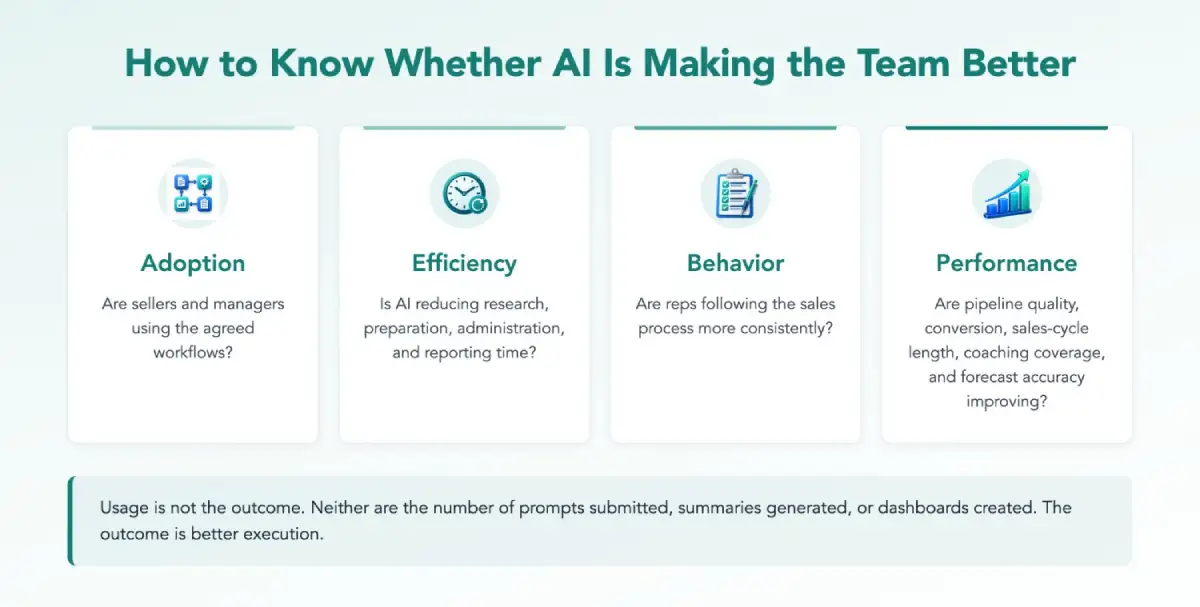
That is the shift from scattered AI activity to a sales practice that scales.

Sources: McKinsey & Company, “The State of AI in 2025: Agents, Innovation, and Transformation,” November 2025. Gartner, “Gartner Survey Finds 69 percent of B2B Buyers Turn to Sales Reps to Validate AI-Generated Insights,” Gartner Newsroom, May 20, 2026. Gartner, “Gartner Survey Finds Sales Organizations That Provide AI-Enabled Next Best Actions Are 2.6x More Likely to Achieve Commercial Growth,” Gartner Newsroom, May 20, 2026. Gartner, “Gartner Survey Finds AI Saves Sellers Nearly Five Hours Per Week, Yet 72 percent of Sales Organizations Fail to Reinvest Time in High-Value Activities,” Gartner Newsroom, May 19, 2026.